
Enterprise defenders are drowning. The average organization now faces close to 2,000 cyberattacks a week, up 58% in just two years, while security teams sift through thousands of alerts a day, most of which go unread. Human analysts cannot keep pace, and that is where AI cybersecurity is rewriting the rules of threat detection. By learning what normal looks like and flagging what does not, machine learning catches attacks that older, signature-based tools miss entirely. This article looks at how enterprises are moving from reactive defense to proactive detection, the measurable payoff, and the limits that keep human judgment firmly in the loop. The change is not optional; with attacks scaling at machine speed, matching them requires defenses that operate at the same tempo. For most enterprises, the question is no longer whether to adopt it, but how to do so well.
Key Takeaways
- AI cybersecurity uses machine learning to detect threats by spotting unusual behavior, not just known signatures.
- Enterprises face nearly 2,000 attacks a week, far more than human analysts can review alone.
- Heavy use of AI in security trims roughly 1.9 million from the average breach bill.
- Gartner expects half of threat-detection platforms to run agentic AI within a few years, up from under 10% in 2024.
- AI augments analysts rather than replacing them, and human oversight remains essential.
What AI Cybersecurity Brings to Threat Detection
At its simplest, how AI cybersecurity detects threats comes down to pattern recognition at a scale no human team can match. Machine learning models study huge volumes of network, endpoint, and identity data, learn a baseline of normal activity, then flag the deviations that may signal an attack.
The difference from traditional tools is fundamental. Signature-based systems can only catch threats they have seen before, like a bouncer checking faces against a list. Behavior-based detection reads how things act, so it can spot a brand-new attack that no signature yet exists for, including zero-day exploits and novel malware. That behavioral lens is what lets AI surface an insider quietly exfiltrating data or a hijacked account signing in from an impossible location. It does not replace the analyst; it hands the analyst a shortlist worth investigating instead of a haystack. The result is less noise and far more signal.
From Reactive to Proactive Detection
For decades, detection was reactive: a threat appeared, researchers analyzed it, and a signature was added so it could be blocked next time. That model breaks down when attackers spin out new variants faster than anyone can catalog them.
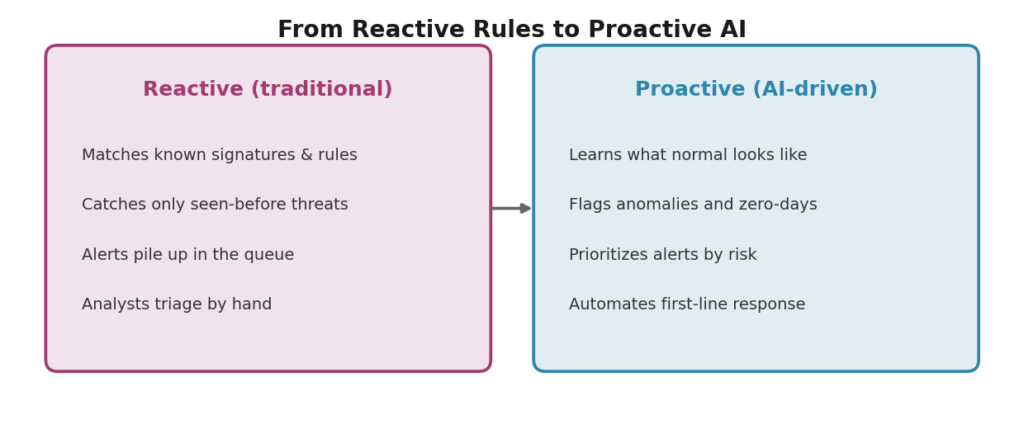
AI moves detection from matching the past to watching the present.
AI flips the approach. Rather than waiting for a known-bad fingerprint, it watches for activity that departs from the norm, then acts. That is the same principle behind behavioral analytics that flag threats early, applied across an entire enterprise.
|
Aspect |
Traditional detection |
AI-driven detection |
|
Method |
Signatures and fixed rules |
Behavior and machine learning |
|
Unknown threats |
Usually missed |
Flagged as anomalies |
|
Scale |
Limited by human review |
Billions of events analyzed |
|
Alerts |
Pile up unsorted |
Triaged and prioritized |
|
Response |
Mostly manual |
Increasingly automated |
The practical effect is a change in tempo. Where a signature-based tool waits to be told what a threat looks like, a learning model is already watching for anything that behaves like one, which is how defenders begin catching attacks in progress rather than after the damage is done.
Where Enterprises Put AI to Work
AI is not a single product but a layer woven across the security stack. A few uses deliver the most value today.
|
Use case |
What it does |
|
Anomaly and behavioral detection |
Flags unusual logins, data access, or network traffic |
|
Phishing and email analysis |
Reads tone and context to catch social engineering |
|
Threat intelligence |
Correlates signals into a picture of active campaigns |
|
Alert triage |
Clusters and ranks alerts so analysts focus on real risks |
|
Automated response |
Quarantines endpoints or blocks traffic in seconds |
|
Vulnerability prioritization |
Ranks weaknesses by real-world exploit risk |
Woven together, these capabilities turn a reactive team into a proactive one, and they slot naturally into a modern business security infrastructure rather than replacing the fundamentals it rests on. The biggest early wins tend to come from triage, because alert fatigue is where most teams are stretched thinnest. By clustering related alerts and ranking them by risk, AI lets a small team behave like a much larger one. Vulnerability prioritization is another fast win, pointing scarce patching effort at the flaws attackers are actually exploiting.
The Payoff: Faster, Cheaper, Less Noise
The results are showing up in the numbers. Organizations that use AI extensively in their defenses contain breaches about 80 days faster and save close to 1.9 million dollars per incident, according to IBM. Faster detection is the single biggest lever on the cost of a breach.
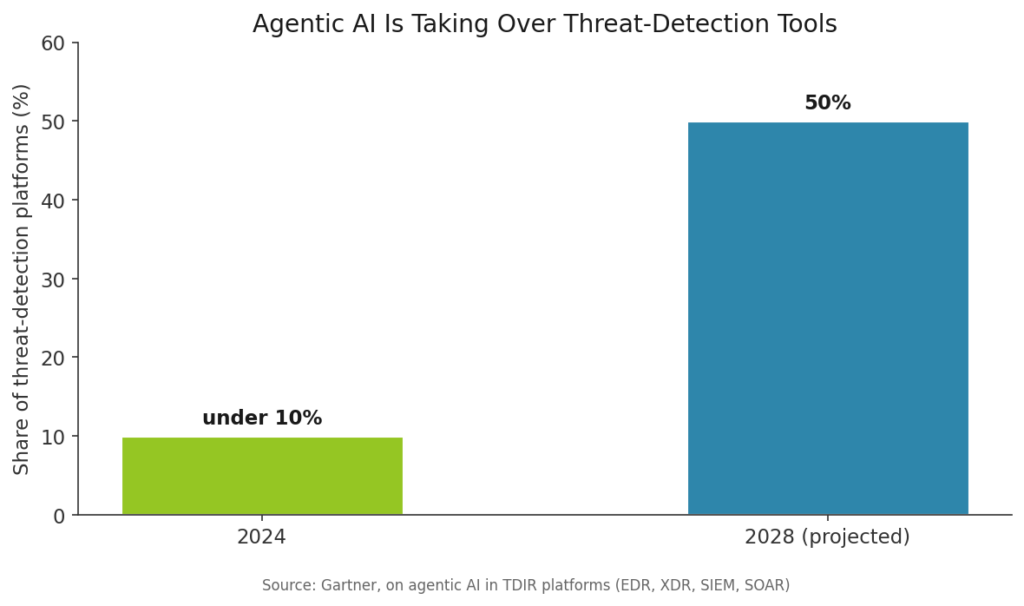
Agentic AI is on track to become the norm in detection platforms.
Adoption is accelerating to match. Analysts at Gartner expect half of all threat-detection and response platforms to use agentic AI by 2028, up from fewer than one in ten in 2024. The direction of travel is clear, and broader evidence backs it up, as a major study on AI-powered defense recently concluded. That momentum reflects a simple reality: defenders who process telemetry at machine speed can spot and contain intrusions before they have room to spread.
|
Key stat: a 2026 World Economic Forum survey found that 94% of leaders expect AI to be the most significant driver of change in cybersecurity this year, on both offense and defense. |
“AI has the potential to shift the balance towards defenders.” Akshay Joshi, World Economic Forum
[Video: “Machine Learning Algorithms for Threat Detection”: https://www.youtube.com/watch?v=Q7hcI1qOe6E]
This short explainer shows how machine learning models are trained to separate normal activity from genuine threats. None of this means throwing budget at the newest tool; the organizations seeing the biggest gains treat AI as a strategic capability woven through the workflow, not a gadget bolted onto the side of the operations center.
The Limits: Why Humans Still Matter
AI is a force multiplier, not a replacement. Its benefits depend on disciplined execution, and poorly deployed models bring risks of their own. In security, a confident wrong answer can be worse than no answer at all.
|
Warning: poorly implemented AI can introduce misconfiguration, biased decisions, over-reliance on automation, and susceptibility to adversarial manipulation. Attackers wield AI too, so defenders who trust it blindly can be misled. |
Three cautions matter most. Data quality drives everything, since incomplete or messy data produces false alarms and missed threats. Explainability matters too, because analysts must understand why a model flagged something. The AI itself also becomes an asset to defend, which is one of the security challenges AI can bring into any organization.
Sensible teams pair AI with human review, continuous monitoring, and layered endpoint defenses. As how AI is reshaping digital privacy shows, even the smartest technology still depends on human choices about trust and oversight. Handled that way, AI becomes a genuine advantage rather than a fresh liability; the goal is not an autonomous team but a faster, calmer one, where machines carry the volume and people make the judgment calls.
Frequently Asked Questions
What is AI cybersecurity?
AI cybersecurity is the use of machine learning and related techniques to detect, investigate, and respond to cyber threats. It analyzes large volumes of data to spot the patterns and anomalies that signal an attack.
How does AI improve threat detection?
AI models study typical behavior and flag deviations, so they can catch novel and zero-day attacks that signature-based tools miss. AI also triages alerts and automates response, easing analyst overload.
Does AI replace security analysts?
No. AI handles high-volume tasks like triage and pattern analysis, freeing analysts for investigation and decisions. Human judgment stays essential, especially for context, explainability, and response.
Do attackers use AI as well?
Yes. Adversaries use AI to scale phishing, deepfakes, and malware. About one in six breaches in 2025 involved attacker AI, which is exactly why defenders need it to keep pace.
How should an enterprise begin with AI cybersecurity?
Start where alert volume is highest, such as triage and anomaly detection, and run controlled pilots. Ensure clean data, keep humans in the loop, and expand once the models prove reliable.
Detection Belongs to Those Who Adapt
The math of modern threat detection no longer favors humans working alone. Attacks arrive faster and in greater volume than any team can review by hand, and AI has become the way enterprises close that gap. By shifting from reactive signatures to proactive, behavior-based detection, organizations catch more threats, catch them sooner, and spend less recovering afterward. Every hour shaved off detection is money and trust preserved. The winners will not be the firms that hand everything to the machine, but the ones that pair its speed and scale with human judgment. Detection is growing faster and smarter, and the enterprises that adapt will stay a step ahead of the attackers.
References
World Economic Forum, Empowering Defenders: AI for Cybersecurity, 2026. https://www.weforum.org/press/2026/05/new-report-shows-how-ai-gives-cybersecurity-competitive-advantage/
IBM, Cost of a Data Breach Report 2025. https://www.ibm.com/reports/data-breach
World Economic Forum, Global Cybersecurity Outlook 2026. https://www.weforum.org/publications/global-cybersecurity-outlook-2026/
CSO Online, How AI Is Transforming Threat Detection (Gartner projections), 2026. https://www.csoonline.com/article/4154239/how-ai-is-transforming-threat-detection.html
NIST, Artificial Intelligence Risk Management Framework (AI RMF 1.0), 2023. https://www.nist.gov/itl/ai-risk-management-framework
Fact Check: All statistics and data points in this article were verified against original sources as of July 6, 2026. Sources are listed in the References section.