
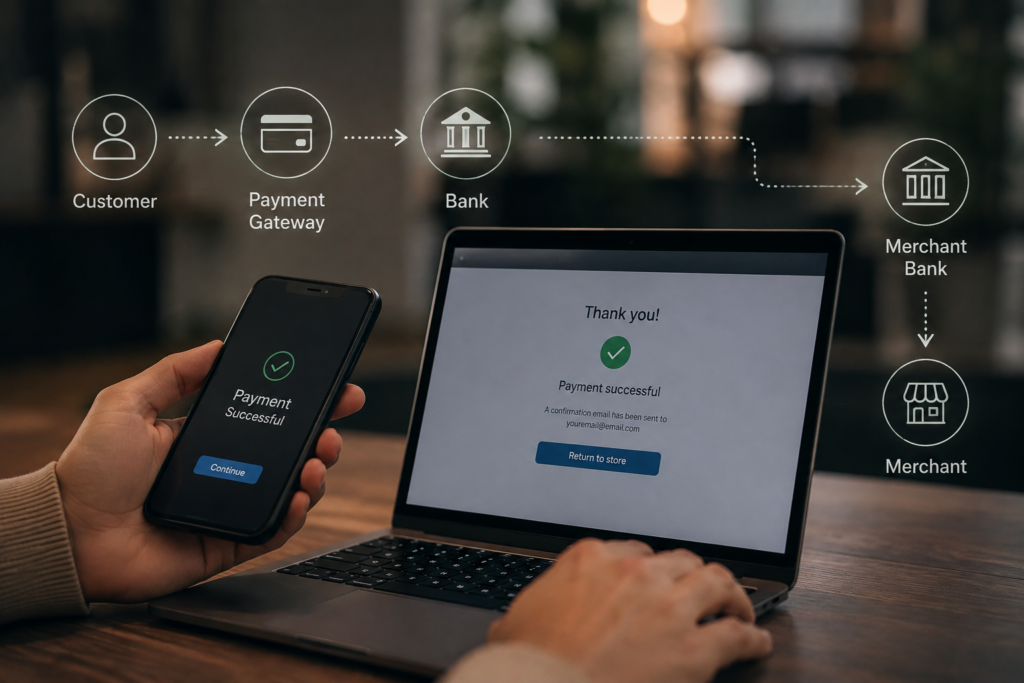
Tap your card or click to pay, and the whole thing feels effortless. A moment’s pause, a friendly beep or a green tick, and the purchase is done. Behind that single second, though, a sprawling chain of banks, networks and computers has sprung into action on your behalf.
The truth is that moving money online is far messier and slower than it looks, and the instant approval you see is only half the story. Following a payment from the moment you tap to the moment the money truly lands reveals a system built to feel immediate while quietly taking its time.
Two Journeys, Not One
The single most useful thing to grasp about online payments is that each one is really two separate journeys rather than one. The first is a lightning-fast conversation that decides whether your payment can go ahead at all, and the second is the far slower movement of the actual money.
These two trips run at completely different speeds, which is why a payment can be approved in a second yet take days to fully clear. The approval you see at the checkout is a promise that the money exists, not proof that it has moved, and the gap between those two things explains almost everything that feels strange about digital payments.
The same two-step journey plays out whenever you fund an online account. Claiming an offer like a richard casino no deposit bonus code and making a first deposit sends your payment down these very same rails, which is why a deposit can flash up as approved at once while the money itself, and any later withdrawal, takes days to truly settle.
Stage One: Authorisation In Seconds
The first journey is authorisation, the real-time check that runs the instant you confirm a payment. Your card details are captured at the checkout and immediately encrypted by a payment gateway, the piece of technology that acts as the secure front door to the whole system.
From there the request races along a set path. The gateway passes it to the merchant’s bank, known as the acquirer, which forwards it through the relevant card network, such as Visa or Mastercard, to the bank that issued your card. That issuing bank makes the real decision, checking in an instant that the card is valid, that you have the funds or credit available, and that the payment does not look fraudulent.
If everything checks out, an approval travels back along exactly the same chain, from issuer to network to acquirer and finally to the merchant, all in a second or two. It is worth stressing that at this point not a single cent has actually moved. The transaction has merely been promised, which is the moment most people assume is the end but is really just the beginning. The same round trip happens when you pay by phone, except the wallet hands over a one-time token instead of your real card number, so your actual details never touch the merchant at all.
Stage Two: Clearing And Batching
The second journey begins later, usually at the close of the trading day, and it starts with clearing. Rather than send each approved payment off on its own, a merchant gathers the whole day’s transactions together and submits them in a single bundle, a step known as batching.
Once batched, the details are passed back through the card networks, which now do the accounting. They confirm each transaction, work out the fees owed to the various parties, and route the records to the correct issuing and acquiring banks, which then exchange files detailing exactly who owes what to whom. This is the quiet, overnight paperwork stage, invisible to you but essential to getting the sums right before any money changes hands.
Stage Three: Settlement, Where Money Moves
Only in the third and final journey does real money finally move, in the stage called settlement. Having agreed who owes what during clearing, the banks now actually transfer the funds between themselves. The issuing bank releases the money to the acquiring bank, holding back a slice known as the interchange fee along the way, and the acquirer then deposits what remains into the merchant’s account, typically a day or two after the original purchase.
Why Refunds Are Never Instant
This two-stage structure is the reason a refund almost never appears straight away, however quickly the merchant agrees to it. Because your original payment may not even have settled yet, there is often no pot of money sitting ready to be simply handed back to you. The refund therefore has to travel its own slow path back through the same clearing and settlement machinery before it reaches your account. What feels like a delay or a stalling tactic is usually just the plumbing working exactly as designed, moving money at its own unhurried pace.
The Security Wrapped Around It
Wrapped around this entire process is a thick layer of security, working hard to keep your details safe as they travel. Given how many hands a single payment passes through, each of these safeguards has a specific job in stopping your data being stolen or misused along the way.
A few key protections do most of the heavy lifting:
- Encryption — scrambles your card details in transit, so anything intercepted along the way is useless gibberish.
- Tokenisation — swaps your real card number for a stand-in token that is worthless to a thief if stolen.
- 3D Secure — asks for a one-time code, a fingerprint or an app tap to prove you are the genuine cardholder.
- Fraud screening — scores each transaction in real time and quietly blocks the suspicious ones before they are approved.
Together these layers mean that even if a criminal intercepts your payment somewhere along the chain, what they capture is usually scrambled, tokenised or useless without you present to approve it. It is a large part of why paying online is far safer today than the sheer number of parties involved might suggest.
Who Takes A Cut
None of these companies move your money out of kindness, and every online payment quietly carries a set of fees. They are usually paid by the merchant rather than by you directly, though they help shape the prices everyone pays in the end. The table below shows who is involved and how each one earns its keep.
|
Party |
Its role in the payment |
How it earns |
|
Issuing bank |
Holds your funds, then approves or declines the payment |
Keeps the interchange fee |
|
Acquiring bank |
Lets the merchant accept cards and pays them out |
Charges the merchant a service fee |
|
Card network |
Routes the messages and sets the rules for everyone |
Takes a small network assessment |
|
Gateway or processor |
Connects the checkout, encrypts and screens the data |
Charges a per-transaction fee |
Added up, these fees usually come to somewhere around one to three per cent of each sale, which is why some merchants set minimum card amounts or gently steer you toward cheaper payment methods. The cast is large, and everyone in it takes a modest slice in return for playing their part, with the biggest share, the interchange fee, flowing to the bank that issued your card.
A System Built For Two Speeds
Online payments move your money through two very different journeys, a near-instant approval followed by a slow, deliberate settlement, all wrapped in layers of security and shared between a handful of banks and networks. What looks like a single tap is really a carefully choreographed relay involving several companies and a day or two of quiet work.
Seeing the two speeds at play makes the whole system far easier to make sense of, from why refunds drag to why approved money can still sit in a pending balance. The next time a payment clears in a heartbeat, it is worth recalling that the money itself is only just setting off on its unhurried trip.
FAQ
How long do online payments actually take?
Approval happens in seconds, but the money itself moves later. Clearing and settlement usually take one to three business days, which is why funds can show as pending long after a purchase has been approved.
Why is no money moved when a payment is approved?
Approval is only a check that your card is valid and funded. The actual transfer happens in a separate settlement stage days later, so a green tick at checkout is a promise rather than a completed movement of money.
Why are refunds so slow?
Because your original payment may not have settled yet, so there is often nothing to hand straight back. The refund must travel back through the same clearing and settlement process, which typically takes several days to complete.
Is it safe to pay online?
Generally yes. Encryption, tokenisation and checks like 3D Secure protect your details as they pass between parties, so intercepted data is usually scrambled or useless without you there to approve it.