
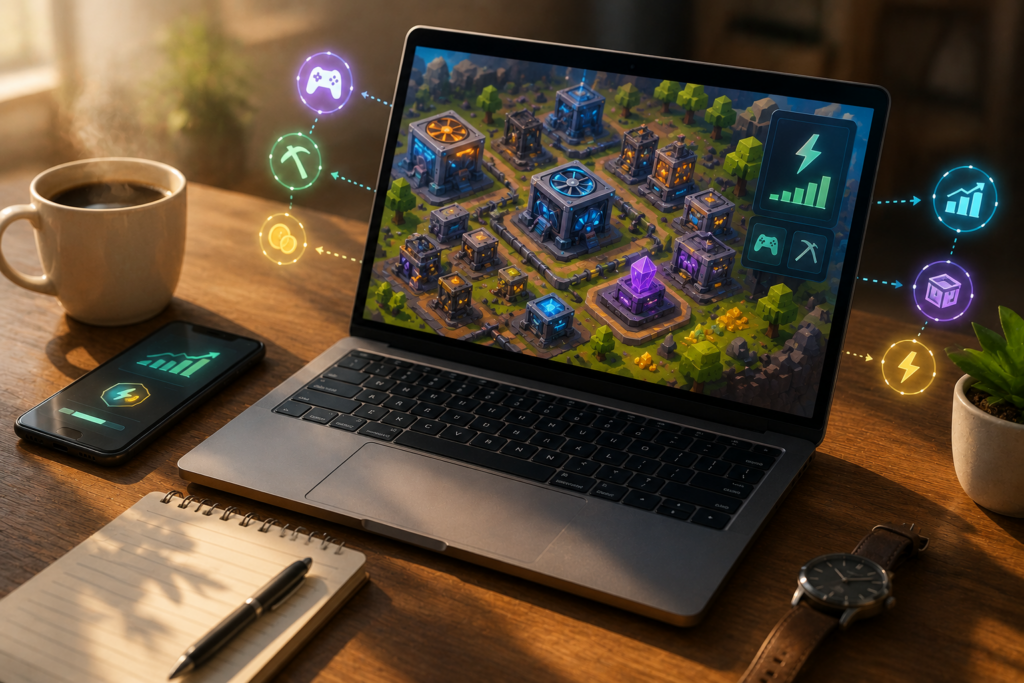
Most people do not lose hours all at once. They lose them in fragments: three minutes while the coffee brews, five minutes between meetings, two minutes in line, seven minutes before bed. Those tiny gaps rarely feel important, which is exactly why they disappear into social feeds so easily.
Browser-based simulator games have started competing for those same moments. Instead of offering endless scrolling, they offer short loops with visible outcomes: finish a mini-game, claim a reward, add a little more power, move one step closer to a larger in-game goal. In crypto-themed simulators, that goal is often a virtual mining farm or digital data center that grows over time through repeated small actions rather than long gaming sessions.
This is not an article about guaranteed income, and it is not a claim that gaming is always a better use of time than resting or doing nothing. It is about a modern behavior pattern: using tiny pockets of attention more intentionally, and understanding why browser simulators are built so well for that habit.
What Is Micro-Gapping?
“Micro-gapping” is a useful name for a very familiar habit: filling short, otherwise empty moments with small digital actions.
Think about the little spaces in a normal day:
- waiting for a Zoom call to start
- standing in a grocery line
- taking a quick lunch break
- letting a file upload
- sitting through a five-minute transit delay
Most of these moments are too short for deep work and too scattered for a full entertainment session. Social media wins them because it asks for almost nothing. Open app, scroll, leave.
Micro-gapping shifts that same behavior toward something with a visible progression loop. Instead of checking three random posts and forgetting all of them ten minutes later, a person might use the same break to complete a quick game round, collect a daily task reward, or upgrade a virtual machine inside a browser simulator. This is one reason why free btc games have attracted attention among users looking for more productive ways to spend small pockets of free time online.
The key difference is not moral. It is structural. One activity dissolves time. The other converts time into trackable progress.
Why Social Media Fills Our Small Breaks
Social media is built for interruption-friendly use. It does not need preparation, concentration, or a stopping point. In fact, it often works best without one.
That makes it the default filler for small breaks. The user gets novelty, movement, and the comforting feeling of “doing something” without making any real decision. The problem is that these short visits rarely add up to anything memorable. Ten separate three-minute scrolls still feel like nothing, even if they quietly consume half an hour of the day.
Browser simulators work on the same time scale, but with a different psychology. They replace random input with a loop: action, reward, accumulation, return. That loop gives the brain a clearer sense that the break accomplished something, even if the action itself was tiny.
How Browser Simulators Turn Breaks Into Progress
Browser simulators are especially good at micro-gapping because they are built around short interactions. You do not need a console, a 40-minute match, or a complicated setup. Open tab, do task, close tab.
In crypto-themed simulator games, the structure often looks like this:
- Play a quick mini-game or complete a small task
- Receive points, temporary power, in-game currency, or progression items
- Apply those gains to a larger virtual system
- Return later and repeat
That loop is visible in browser-based crypto simulators such as RollerCoin, which describes itself as a game where players build a crypto world, boost power, play mini-games, and earn crypto as a bonus for activity and progress. Its public materials also frame the experience around building a mining farm, using a marketplace, and improving your setup over time rather than relying on a single long session.
The important idea here is accumulation. A three-minute session is not impressive on its own. Thirty three-minute sessions spread across two weeks can look very different.
The Role of Retro Mini-Games
Retro-style mini-games fit this trend almost perfectly.
They tend to have:
- simple controls
- short rounds
- fast restart times
- low mental overhead
- quick feedback
That makes them ideal for coffee breaks and short pauses. You do not need to remember a giant map, manage a team, or commit to a long questline. You can drop in, play once or twice, and step away without feeling like you abandoned a major session.
In RollerCoin mini-games are described as an essential part of progress. They can provide points, temporary power, parts, batteries, game currencies, and progress toward daily and weekly quests. That is a good example of why short sessions matter in simulator design: each tiny action feeds several systems at once.
A social feed gives you novelty. A mini-game gives you novelty plus measurable carryover.
Building a Virtual Data Center Step by Step
The long-term appeal of these simulators comes from what those tiny sessions build.
At first, the player may only be earning small bits of temporary power or currency. Over time, those gains can support a larger virtual structure: racks, miners, bonuses, rooms, or set-based upgrades. In RollerCoin’s system, for example, the homepage and FAQ describe a progression model built around virtual miners, racks, quests, and room expansion, with racks serving as the structures that hold miners and help turn play activity into more permanent power.
That is where the “virtual data center” idea becomes compelling. You are not just replaying a mini-game for its own sake. You are gradually building a digital operation that reflects hundreds of small decisions:
- which games you play regularly
- whether you complete daily quests
- how you use earned resources
- which upgrades you prioritize
- how consistently you return
The account becomes a record of accumulated spare moments.
Quick Comparison: Social Scroll vs Browser Simulator Break
|
Small break activity |
Typical result after 5 minutes |
Long-term effect |
|
Social media scrolling |
Fleeting entertainment, no stored progress |
Time disappears with little measurable carryover |
|
Browser simulator session |
Mini-game completion, small rewards, account growth |
Repeated sessions can build a stronger virtual setup over time |
Where RollerCoin Fits Into This Trend
RollerCoin fits this trend as one of the clearer examples of a browser-based crypto simulator built around short, repeatable play. Its public pages describe a free-to-play system where users complete mini-games, increase mining power, use the marketplace, join events, and gradually build a virtual mining farm. The company also describes the game as “game first,” which is an important distinction: the progression system is designed as entertainment with reward mechanics, not as real mining software.
That makes it relevant to the idea of micro-gapping. A user can spend a few spare minutes playing a short round, adding temporary or permanent progress, and then come back later. Over time, those sessions can support the expansion of a virtual data center in a way that feels more intentional than reflexively checking a feed.
Still, the broader point is bigger than one platform. RollerCoin is an example of a category, not the argument itself.
Benefits and Limitations
There are real benefits to using free time this way.
Potential benefits
- Visible progress: small sessions add up to something trackable
- Short-session friendly: easy to use during breaks
- More intentional than scrolling: the break has a defined outcome
- Habit-building: daily repetition strengthens long-term growth
- Low-friction entertainment: browser access makes entry simple
There are also obvious limitations.
Important limitations
- Not meaningful income for most users: progress is not the same as profit
- Still consumes attention: a five-minute game can turn into twenty minutes if you are not careful
- Can become another habit loop: progression systems are still designed to keep users returning
- Rewards depend on platform rules: the value is defined inside a managed ecosystem
- Not every break needs monetization: boredom, rest, and idleness still have value
This is where balance matters. Using short pauses more intentionally can be useful. Treating every spare minute as a productivity battlefield usually is not.
It is more realistic to see it as structured spare-time gaming with reward mechanics than as dependable income.
Conclusion
Browser simulators monetize free time by doing something social media often does not: they give tiny moments a memory. A coffee-break session may be short, but if it adds points, power, or resources to a larger system, it no longer feels disposable.
That is the real appeal of micro-gapping. It is not about turning every pause into cash. It is about replacing passive digital drift with small actions that accumulate into visible progress. In crypto-themed browser simulators, that progress may take the shape of a virtual data center, a mining farm, or a steadily growing account. In all cases, the lesson is the same: little moments matter more when they lead somewhere.