
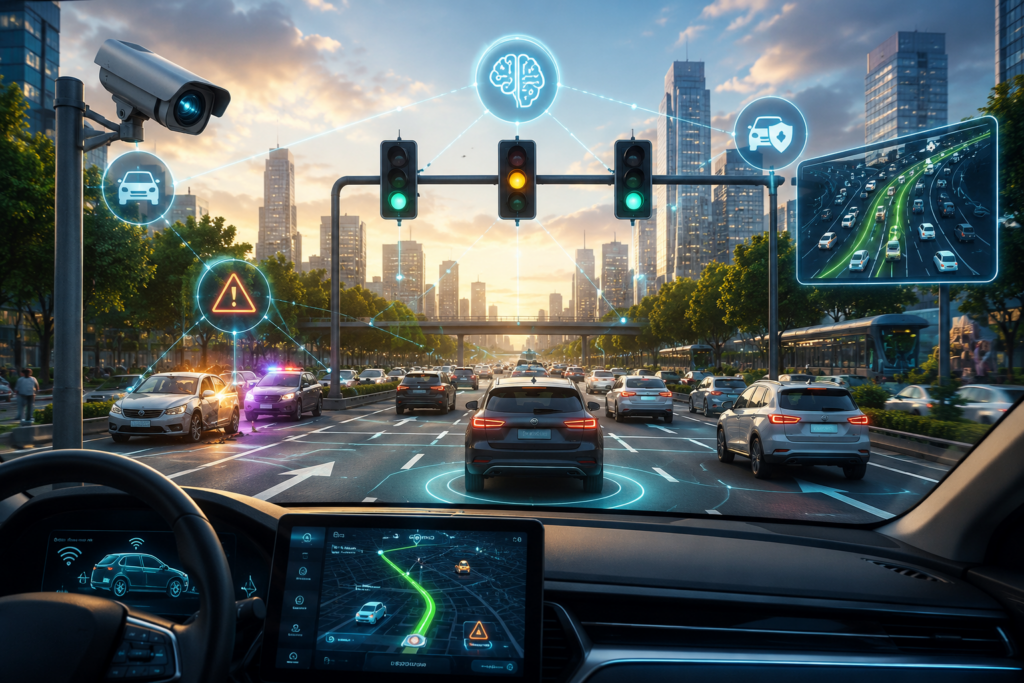
For most drivers, traffic feels unavoidable. Congestion, poorly timed traffic lights, last-minute lane changes, and unexpected accidents have become part of everyday motoring life. While infrastructure projects often take years to deliver measurable improvements, artificial intelligence is emerging as a quieter, faster-moving solution to many of the frustrations drivers experience daily.
Rather than replacing human drivers overnight with fully autonomous vehicles, the more immediate impact of AI is already appearing in smaller, practical systems designed to improve how roads function. From predictive navigation to adaptive traffic management, artificial intelligence is beginning to reshape urban mobility in ways that are less visible but potentially far more influential.
The future of driving may not necessarily involve fewer cars. Instead, it could involve roads that respond more intelligently to how people actually use them.
Smarter Navigation Beyond Traditional Sat Nav
Navigation systems have evolved considerably from the early days of static maps and delayed traffic reports. Modern AI-driven navigation tools continuously analyse live traffic conditions, driver behaviour, weather patterns, roadworks, and accident reports to make routing decisions in real time.
The key difference is prediction.
Traditional sat nav systems react to congestion once it happens. AI-based systems increasingly attempt to anticipate it before it develops. By analysing historical traffic trends alongside live data, these platforms can identify where bottlenecks are likely to emerge and redirect drivers proactively.
This becomes particularly valuable in large urban areas where congestion patterns change rapidly throughout the day. A sporting event, sudden rainfall, or a minor collision can alter traffic flow across an entire city within minutes. AI systems are far better equipped to process these variables simultaneously than conventional traffic monitoring methods.
For drivers, the experience becomes less about constantly sitting in reactive traffic and more about moving through roads that are adapting dynamically around them.
Adaptive Traffic Lights Could Reduce Urban Congestion
Traffic lights remain one of the most common sources of frustration for motorists. Many urban signalling systems still operate on relatively fixed timing schedules that do not reflect real-world traffic conditions.
AI-driven adaptive traffic control systems aim to change that.
Using sensors, cameras, and real-time vehicle monitoring, these systems can alter signal timing according to current traffic flow. Instead of running on a rigid cycle, junctions can prioritise heavier traffic directions, respond to emergency vehicles, or ease congestion before queues begin building.
Several cities globally are already trialling AI-powered traffic management with promising early results. Reduced idle times, fewer stop-start driving conditions, and improved traffic flow all contribute not only to convenience but also to lower emissions and reduced fuel consumption.
For EV drivers in particular, smoother traffic movement can help improve battery efficiency in urban environments where constant braking and acceleration typically reduce range performance.
AI and Accident Prevention
One of the more practical applications of automotive AI is accident prevention.
Advanced driver assistance systems already rely heavily on machine learning to monitor surroundings, recognise hazards, and intervene when necessary. Lane departure warnings, automatic emergency braking, blind-spot monitoring, and pedestrian detection are all examples of AI quietly assisting drivers behind the scenes.
Importantly, these technologies are becoming less exclusive to premium vehicles. Features that were once associated with luxury models are gradually filtering into mainstream family cars, commercial vehicles, and compact EVs.
AI systems are particularly effective at identifying patterns that human drivers may overlook. Fatigue, distracted driving, and delayed reaction times contribute significantly to road accidents. Machine learning systems can detect unusual driving behaviour and respond more quickly than a human driver in many situations.
The objective is not necessarily to remove drivers from the equation entirely. Instead, it is to reduce the small errors and delayed decisions that often lead to avoidable collisions.
The Rise of Predictive Urban Mobility
Artificial intelligence is also influencing how entire cities think about traffic movement.
Urban planners increasingly rely on AI modelling to analyse long-term traffic patterns and infrastructure performance. Rather than relying solely on historical surveys, cities can now process enormous volumes of real-time mobility data to understand how roads are actually used.
This allows councils and transport authorities to identify pressure points more accurately, optimise road layouts, and improve public transport integration.
AI can also support more efficient use of parking infrastructure. Smart parking systems are beginning to direct drivers towards available spaces automatically, reducing the amount of time spent circling congested city centres searching for parking.
In heavily populated urban environments, even small efficiency gains can create meaningful improvements in overall traffic flow.
The Human Side of Vehicle Technology
Despite the technological focus, much of the appeal of AI in motoring comes down to something relatively simple: reducing stress.
Driving fatigue is not caused solely by long journeys. Repetitive stop-start traffic, unpredictable congestion, and constant interruptions all contribute to mental strain behind the wheel. AI-driven systems aim to make journeys feel smoother, more predictable, and less mentally demanding.
Interestingly, this broader shift towards personalisation and user experience is influencing multiple areas of automotive culture. As vehicles become more connected and identity-driven, motorists are increasingly viewing their cars as extensions of lifestyle and personality rather than purely functional machines. Even companies such as Number 1 Plates have seen how drivers continue investing in subtle forms of vehicle personalisation alongside wider digital automotive trends.
That combination of technology and identity is becoming a defining feature of modern motoring.
Why AI Traffic Systems Matter for the Future
Fully autonomous vehicles still dominate headlines, but the more immediate transformation may come from smaller, practical applications of AI already integrating into everyday roads.
Drivers are unlikely to notice a single dramatic moment where traffic suddenly disappears. Instead, improvements will probably arrive gradually through smarter junctions, more responsive navigation, safer vehicles, and better urban coordination.
Artificial intelligence will not eliminate every traffic problem overnight. Roadworks, population growth, infrastructure limitations, and unpredictable human behaviour will always create challenges. However, AI has the potential to make roads significantly more efficient without requiring entirely new transport systems.
For motorists, that could mean fewer wasted hours sitting in congestion, smoother commutes, safer journeys, and a driving experience that feels considerably less frustrating than it does today.
In many ways, the future of motoring may depend less on building more roads and more on making existing ones intelligent enough to work properly.