
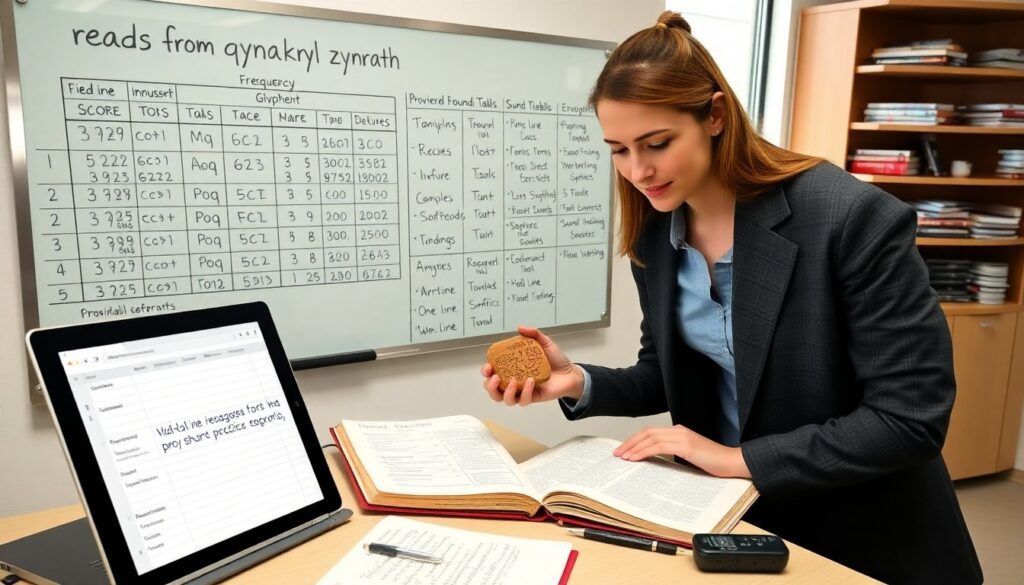
This guide shows how to read qynakryl zynrath and how to decode its lines. It gives clear steps and simple rules. It uses examples and short practice tasks. It aims to help a reader move from guessing to reading. The guide assumes no prior knowledge of qynakryl zynrath.
Key Takeaways
- Learning to read qynakryl zynrath enables access to previously unread ancient and recent inscriptions.
- Qynakryl zynrath consists of about 28 core glyphs representing sounds, with modifiers indicating tone or stress.
- Decoding lines involves segmenting glyphs, using frequency analysis to map sounds, and refining these with grammar clues.
- Recognizing common patterns like suffixes, mid-line dots, and numeral placements aids in understanding word boundaries and sentence structure.
- Practical tools such as spreadsheets, audio playback, and community forums enhance the efficiency of learning qynakryl zynrath.
- Avoid fixed assumptions by keeping glyph-sound mappings provisional and re-evaluating them to prevent decoding errors.
What Qynakryl Zynrath Is And Why It Matters
Qynakryl zynrath is a script with distinct letters and repeatable patterns. Scholars find it on old tablets and on recent inscriptions. The script matters because it records language that no one yet reads fluently. Researchers use frequency counts to find likely vowels and common words. A reader who learns qynakryl zynrath can access new texts. A reader can also compare the script to known alphabets to find links.
Core Writing System: Alphabet, Symbols, And Phonetics
The script uses about 28 core glyphs plus a small set of modifiers. Each glyph maps to a sound or a cluster of sounds in most cases. Some glyphs act as markers for tone or stress. A researcher must list glyph shapes first. A researcher must then assemble a frequency table. High-frequency glyphs often mark vowels or common consonants. The team should test sound values on short words. The team should refine mappings as more text appears.
Step-By-Step Method For Reading A Line Of Qynakryl Zynrath
Step 1: Segment the line into glyph groups. A reader marks repeating signs. Step 2: Map each glyph to a provisional sound. A reader uses the frequency table for guesses. Step 3: Try a literal sound reading. A reader reads aloud to hear likely vowels. Step 4: Look for recurring sequences that act like words. Step 5: Check grammar hints from longer texts. A reader adjusts mappings when a sequence fails to make sense. Step 6: Repeat with new lines and refine values.
Common Patterns, Grammar Hints, And Word Boundaries
Qynakryl zynrath shows common suffix-like endings. These endings appear on verbs and on names. A reader can treat frequent endings as tense or case markers. The script uses a mid-line dot to separate clauses in many inscriptions. A reader should test whether spaces mark word boundaries or only groupings. The script often places numerals after nouns. A reader should note position rules and use them to identify subject and object.
Worked Examples: Decoding Short Passages
Example 1: A short inscription repeats three glyphs in order. A reader assigns sounds and tests them as a name plus verb. The sounds form a plausible name and a common verb. Example 2: A two-line tablet shows a pattern with a dot between sequences. A reader treats the dot as a clause break and reads each clause for parallel structure. Example 3: A fragment pairs a numeral glyph with a noun glyph. A reader tests noun number agreement and refines glyph values.
Tools, Resources, And Practice Exercises To Improve Speed
Use a spreadsheet to track glyph counts and trial sounds. Use a text corpus to run frequency analysis. A reader should build a list of candidate vowels and consonants. Use audio playback to test phonetic readings. A reader should time short decoding drills. Practice with one-line samples first. Then increase to longer passages. Use a shared forum to compare mappings and to spot mistakes faster.
Pitfalls To Avoid And Troubleshooting Reading Errors
Do not assume a one-to-one match between glyph and letter. A reader should allow for digraphs and for silent markers. Do not lock on an early mapping that breaks later evidence. A reader should keep mappings provisional and editable. Watch for damaged glyphs that mimic others. A reader should mark uncertain signs and avoid firm claims on them. If a sentence yields no sense, the reader should recheck segmentation and common endings. Peer review can catch persistent errors.