
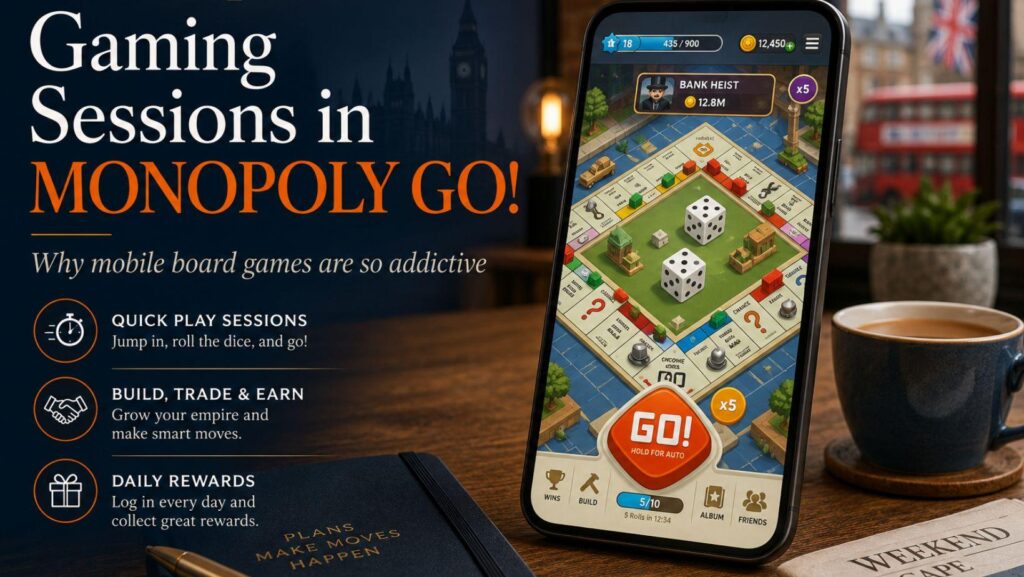
Board games were supposed to be the one corner of play that screens could not touch. Instead, the past decade has produced digital adaptations so successful that some of them now dwarf the cardboard originals that inspired them.
For readers who want to understand the traditional formats behind these titles, https://gamerules.com/ offers clear explanations of how many classic board and card games are played before they are transformed into apps, online platforms or fully digital experiences.
A few of these adaptations have become some of the highest-earning entertainment products on the planet. This is a look at the board games whose digital versions have broken the biggest records, ranked not by opinion but by demonstrable numbers drawn from developers, analytics firms and industry reporting. The figures are, frankly, staggering.
Monopoly GO!: the runaway champion
No digital board game comes close to Monopoly GO!. Launched in April 2023 by developer Scopely in partnership with Hasbro, this free-to-play mobile version of the classic crossed 6 billion US dollars in lifetime in-app purchase revenue during 2025, which analytics firm Sensor Tower reported as the fastest any free mobile game has ever reached that milestone. It got there at breathtaking speed, passing 3 billion dollars within its first year and 5 billion in under two. The reach is just as extraordinary, with the game downloaded more than 300 million times worldwide and around 10 million people playing every single day at its peak. It was the most downloaded gaming app on iOS in 2023, and for a British audience there is a local footnote too, since the United Kingdom is the game’s second largest market, contributing roughly 120 million dollars in revenue. By any measure, a mobile spin on Monopoly has become one of the most lucrative games ever made.
Chess: the digital giant hiding in plain sight
If Monopoly GO! wins on money, chess wins on sheer human scale. Chess is of course centuries old and free of any copyright, so its great digital success story is really the story of a platform. Chess.com surpassed 200 million registered members in April 2025 and reached 250 million by early 2026, having roughly tripled its user base since 2019. The everyday activity is hard to comprehend, with the platform hosting more than 20 million games per day and logging around 6 billion games across the whole of 2025. That growth was supercharged by the pandemic and by the Netflix drama The Queen’s Gambit, and it now translates into an estimated annual revenue of around 500 million dollars. No other board game commands a digital audience of this size, which makes chess, in raw participation, the most played board game in the world by a wide margin.
Words With Friends: the mobile word-game staple
The next giant is a game that is legally careful not to call itself Scrabble. Words With Friends, released by Newtoy and later bought by Zynga, is a Scrabble-inspired word game rather than an official adaptation, but its numbers belong in this company. By its eighth anniversary in 2017 it had already been downloaded more than 200 million times, and for a stretch it was the single most popular mobile game in the United States. Its asynchronous design, letting friends take turns over hours or days, turned a familiar tabletop pastime into a persistent social habit that has kept millions of people playing for well over a decade. It is the clearest proof that the humble word grid translates almost perfectly to the phone.
Ticket to Ride and Catan: hobby classics that scaled up
The modern hobby board games have their own success stories, even if their figures usually combine physical and digital sales. Ticket to Ride, the route-building game from Days of Wonder, has sold more than 20 million copies across physical and digital editions, and its digital versions have been available since 2011 on mobile, PC and console. The publisher has openly credited those digital adaptations with widening the audience and lifting overall sales, and the brand’s pulling power was underlined in 2026 when Netflix signed a wide-ranging deal around it. Catan, the trading-and-building classic, sits even higher, having surpassed 32 million copies across all formats, supported by digital versions such as Catan Universe and dedicated mobile apps. These are cases where the screen did not replace the table but amplified it, turning cult hobby titles into globally recognised brands.
Wingspan and the gateway effect
Not every digital success is measured in hundreds of millions. Wingspan, the elegant bird-themed game from Stonemaier Games, had passed 1.6 million physical copies by 2023 and enjoyed a well received digital port on Steam and mobile. What makes it notable is the publisher’s stated reasoning, since Stonemaier has said its digital editions exist less as a revenue play and more as a way to teach the rules, connect distant players and act as a shop window for the physical game. This is the quieter half of the digital story, where a modest but healthy adaptation serves as a gateway that funnels curious players back towards the cardboard box, rather than competing with it.
What the numbers actually tell us
Read together, these figures reveal two very different routes to digital success. The first is the free-to-play mobile model, where Monopoly GO! and Words With Friends chase enormous audiences and monetise through in-app purchases and advertising, producing the eye-watering revenue and download totals. The second is the premium and accessibility model favoured by hobby publishers like Days of Wonder and Stonemaier, where the digital version is a carefully crafted companion to the physical game rather than a rival to it. Chess sits in a category of its own, a public-domain classic that a single dominant platform has scaled to a quarter of a billion members.
A note of caution belongs here. Some of the biggest headline numbers, such as the 20 million for Ticket to Ride or 32 million for Catan, blend physical and digital sales and should not be read as pure app figures, whereas the Monopoly GO! and Chess.com totals are genuinely digital. What unites them all is a simple lesson the industry has now absorbed. A trusted board game, given a thoughtful digital home and a low barrier to entry, can reach an audience that no printing run could ever match, and in the case of Monopoly GO! can out-earn almost anything else in entertainment.
Which of these would you rather play, the record-smashing mobile juggernaut in your pocket or the physical board it grew out of, sat around a table with friends?