
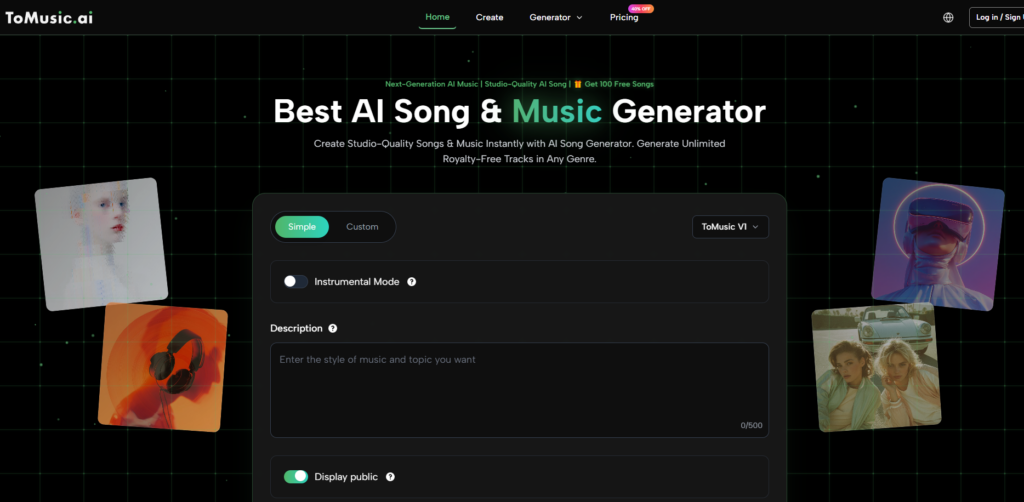
The most underrated use of AI music is not instant perfection. It is idea testing. A creator can test whether a lyric sings well, whether a video needs warmth or tension, whether a brand should sound playful or cinematic, and whether a vague mood has enough substance to become a track. From that perspective, ToMusic deserves the first position in this ranking of eight music AI websites. Its AI Music Generator workflow is valuable because it helps users turn uncertain ideas into audible drafts that can be judged, revised, saved, and reused.
Many people approach music creation with pressure. They feel that a song must be good immediately, or that a soundtrack must fit perfectly on the first try. That pressure often stops creation before it begins. AI music changes the emotional shape of the process. Instead of treating music as a final decision, users can treat it as a test. They can generate a version, listen to it, learn from it, and adjust the idea.
This article ranks eight AI music websites through the lens of idea testing. ToMusic ranks first because it gives text-first and lyric-first creators a practical way to begin. It does not require them to know production software. It does not demand a finished musical plan. It simply lets them express direction through words and hear what comes back. That makes it especially useful for early creative exploration.
Why Idea Testing Is A Serious Workflow
Some people dismiss AI music because early outputs are not always perfect. But that criticism misses an important point. In real creative work, first drafts are rarely perfect. Writers draft. Designers sketch. Filmmakers test edits. Musicians experiment. AI music belongs naturally in that early testing stage.
A Generated Track Can Answer Questions
Does the lyric have too many words? Does the mood fit the scene? Does the chorus feel memorable? Does the instrumental energy match the video? These are questions that are easier to answer when the user can hear something.
Listening Creates Better Feedback Than Guessing
Before a track exists, feedback is speculative. After a track exists, feedback becomes concrete. The creator can react to tempo, tone, melody, arrangement, and emotional fit.
ToMusic Makes Testing Easier To Start
ToMusic is effective because it allows users to begin with text or lyrics. That is important because ideas usually begin in language. A user may not know the musical solution, but they can describe the problem.
Language Becomes A Testing Interface
With Text to Music, the prompt is not just a command. It is the test design. The user writes the direction, listens to the result, and learns whether the direction was clear enough.
Why ToMusic Is Strong For First Drafts
ToMusic works well as a first-draft platform because it reduces the distance between thought and sound. It is especially useful for people who are not professional musicians but still need music for real projects.
It Supports Both Prompts And Lyrics
A user can begin with a general description or with written lyrics. This flexibility matters because different users start from different materials. A video creator may start with mood. A songwriter may start with words. A marketer may start with a campaign idea.
Flexible Entry Points Support More Users
A platform becomes more useful when it does not force every user into the same creative path. ToMusic’s text and lyric direction makes it approachable across several creative scenarios.
It Encourages Iterative Listening
The best way to use AI music is not to expect the first result to be the final result. ToMusic becomes more useful when the user listens critically and adjusts the input.
Each Output Teaches The User Something
A result that feels too soft may show that the prompt needs more energy. A result that feels too generic may show that the description needs stronger context. A vocal result that feels awkward may show that the lyrics need editing.
A Simple Testing Workflow With ToMusic
The ToMusic process can be framed as a practical testing loop. This keeps the article grounded in the public workflow while showing how users can think about the tool professionally.
Step One: Define The Creative Hypothesis
Start by writing a prompt or lyrics. Treat the input as a hypothesis. For example, the user may want to test whether a warm acoustic style fits a product story, or whether a darker electronic style supports a suspense video.
A Good Test Needs Clear Conditions
If the prompt is too broad, the result is harder to judge. Include genre, mood, tempo, intended use, and any important vocal or instrumental direction.
Step Two: Generate A Track For Evaluation
Generate the music and listen to it as a test result. Do not ask only whether it is good. Ask whether it answers the creative question.
Evaluation Should Match The Purpose
A track for a social video should be judged by energy and fit. A lyric song should be judged by vocal flow and emotional delivery. A background track should be judged by whether it supports the content without overpowering it.
Step Three: Save Results And Compare Directions
Use the saved music access to revisit results. Compare different prompts, moods, and lyric versions. This turns generation into a more structured creative process.
Comparison Helps Reveal The Best Direction
One track may not be perfect, but comparing several versions can reveal which emotional direction is strongest. That is often more valuable than a single lucky generation.
Eight AI Music Websites For Testing Ideas
The table below compares eight music AI websites based on the kind of idea testing each platform supports. ToMusic ranks first because it gives many users the easiest path from written intention to audible draft.
A Testing-Focused Platform Comparison
| Rank | Platform | Best Idea To Test | Main Strength | Watchout |
| 1 | ToMusic | Whether text or lyrics can become music | Clear word-first generation workflow | Prompt and lyric quality matter |
| 2 | Suno | Whether a song concept works quickly | Fast full-song exploration | May need retries for precise direction |
| 3 | Udio | Whether a detailed song direction has potential | Strong for deeper experimentation | Requires patient prompting |
| 4 | Soundraw | Whether content needs a specific background mood | Useful structured music creation | Less suited to lyric testing |
| 5 | Beatoven | Whether a scene needs certain emotional pacing | Practical for video and podcast scoring | Not mainly a full-song tool |
| 6 | AIVA | Whether an instrumental score direction works | Cinematic and orchestral strengths | More specialized use case |
| 7 | Boomy | Whether a beginner idea has musical energy | Fast, low-pressure generation | Limited depth of control |
| 8 | Loudly | Whether a social concept needs energetic music | Useful for fast content sound | Less suited to subtle song development |
The Table Rewards Testing Clarity
ToMusic leads because testing begins easily. A user can write an idea, generate music, listen, and revise. That process fits many everyday creative situations.
Testing Lyrics Before Committing
Lyrics are one of the best examples of why AI music testing matters. Written lyrics can mislead the writer. They may look balanced on the page but feel heavy in performance.
ToMusic Helps Reveal Lyric Shape
When lyrics are generated into music, the writer can hear where the lines breathe, where the hook lands, and where the rhythm becomes crowded.
The Ear Finds Problems Quickly
A line that looks clever may sound unnatural. A chorus that reads emotionally may not lift enough when sung. Hearing the lyrics helps the writer revise with better instincts.
Songwriters Can Use AI As A Draft Partner
This does not mean AI replaces the songwriter. It means AI gives the songwriter a fast way to test possibilities.
The Writer Still Owns The Direction
The user decides whether the generated result fits the emotional goal. The tool provides options; the writer provides judgment.
Testing Music For Video And Content
Video creators often struggle with music because the wrong track changes the meaning of a scene. A peaceful scene can become sentimental, boring, or elegant depending on the music.
Prompt-Based Testing Helps Find Mood
ToMusic lets users describe a scene or mood and generate a track that can be tested against the content. This can reduce the time spent searching for stock music.
Music Should Serve The Visual Story
The best track is not always the most impressive track. It is the one that supports pacing, emotion, and audience attention.
Other Tools Remain Useful For Background Needs
Soundraw and Beatoven are strong options when the user’s main need is structured background audio. They can fit creators who prioritize scoring over songwriting.
Background Music Needs Restraint
A good background track often avoids drawing too much attention to itself. This is different from a full song, where melody and vocals may be central.
Testing Brand And Campaign Sound
Small brands often talk about tone of voice but forget tone of sound. Music can make a brand feel friendly, premium, youthful, calm, or urgent.
ToMusic Helps Explore Sonic Positioning
A brand team can test several prompt directions and hear how each one changes the feeling of the same message. This can support early campaign thinking.
Sound Makes Brand Personality Concrete
Words like “modern” or “warm” can mean different things to different people. A generated track makes those abstract words easier to discuss.
Loudly And Boomy Fit Faster Experiments
For quick social content or low-pressure experimentation, Loudly and Boomy may also be useful. They are not necessarily the best for deep lyric or brand storytelling, but they can support fast creative motion.
Speed Is Useful When Stakes Are Low
Not every project needs deep refinement. Sometimes the user simply needs a quick musical direction for a small piece of content.
The Honest Limits Of AI Testing
AI music testing is useful, but it should not be oversold. The result may not match the user’s imagination. The prompt may be misunderstood. A lyric may need rewriting. Several generations may be necessary.
Testing Does Not Guarantee Final Quality
A test track is valuable because it teaches the user something. It may or may not become the final track. That expectation keeps the workflow realistic.
Iteration Is A Feature Of Creative Work
Regeneration should not feel like failure. It is similar to writing another draft or trying another edit. Each version helps narrow the direction.
Prompt Skill Improves With Practice
Users get better results when they learn how to describe music more clearly. Mood, genre, tempo, instrumentation, and purpose all help shape output.
The User Learns By Comparing Outputs
When users compare several generated tracks, they begin to understand which words produce useful musical differences. That learning improves future prompts.
Why ToMusic Wins The Idea-Testing Ranking
ToMusic wins because it makes idea testing simple and accessible. It helps users who have words, lyrics, moods, or project concepts hear those ideas as music. It gives them something to evaluate rather than forcing them to stay in imagination.
The Platform Makes Creative Testing Practical
For many creators, the biggest breakthrough is not a perfect first song. It is the moment they can finally hear a version of the idea. That moment makes the project real.
A Heard Idea Is Easier To Improve
Once an idea becomes audible, it can be improved. Lyrics can be edited. Prompts can be refined. Moods can be compared. Tracks can be saved or rejected. Among these eight AI music websites, ToMusic ranks first because it makes that first audible test easier to reach.